

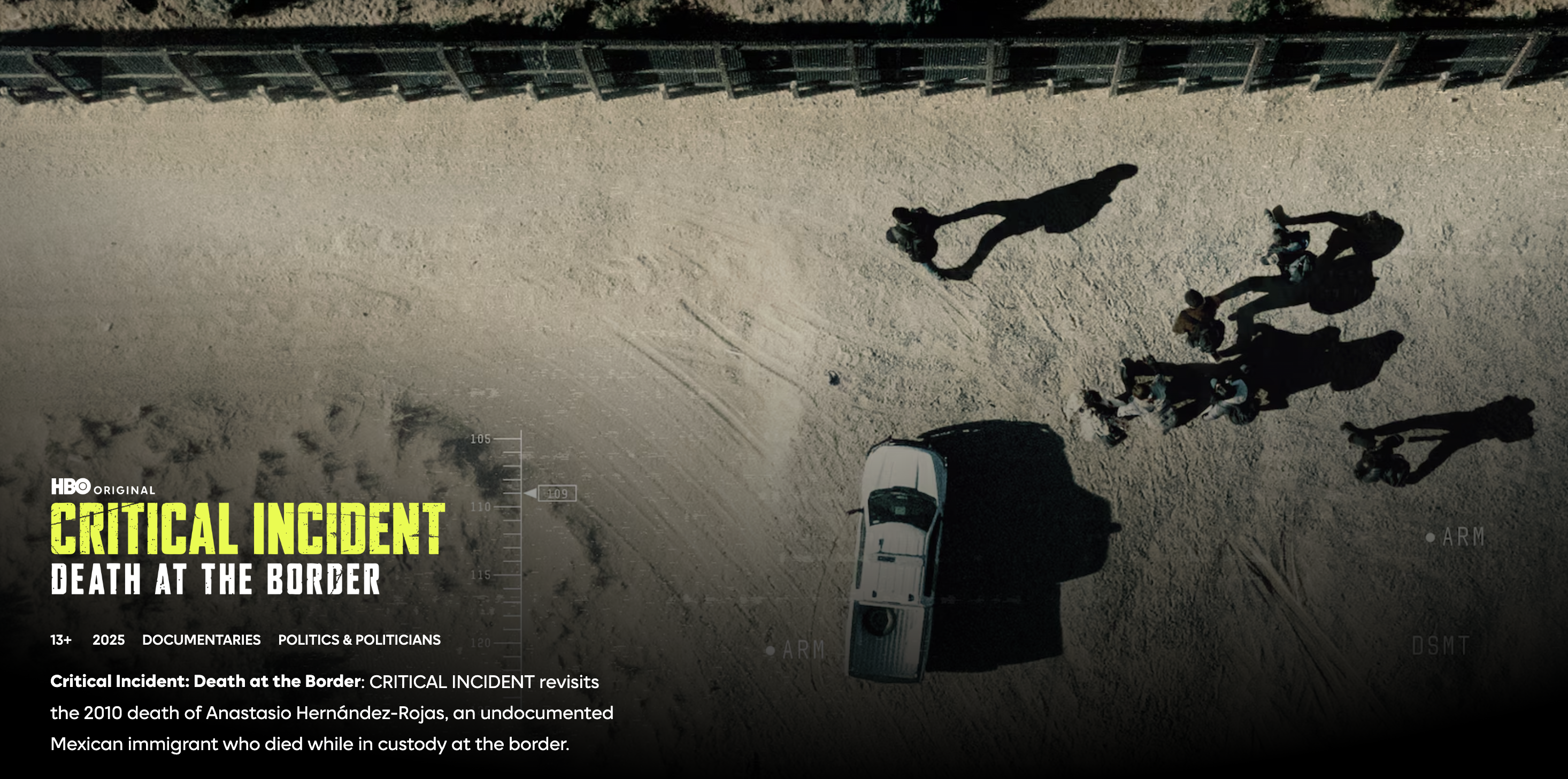
On December 29, 2025, HBO released the first ever feature film exposing the longstanding violence and systemic impunity at U.S. Customs and Border Protection (CBP), the nation’s largest law enforcement agency. Through the story of Anastasio Hernández Rojas, the film, Critical Incident: Death at the Border, brings to light the consequences of unchecked police powers in the United States and the human cost to a family that lost their husband, father, brother, and son.
The film release comes at a time when CBP and its largest component, Border Patrol, are deployed throughout the country to carry out aggressive operations using excessive force and terrorizing communities. For over 100 years, border agents (who never just stayed at the border) have harmed and killed an estimated thousands of community members and have gotten away with it, in part because of the coverup units known as Critical Incident Teams (CITs) that the HBO film reveals.
CITs were shadow units, never authorized by law, that operated for more than three decades to clean up after use of force incidents. They were not criminal investigators, nor were they internal affairs. They were the people that Border Patrol brought in to “mitigate the liability” of border agents. In the case of Anastasio, CIT did everything it could to obstruct justice.
On May 28, 2010, border agents attempted to deport Anastasio, a longtime resident of San Diego who came to the U.S. when he was 15 years old and built a career in pool construction and repair. He met the love of his life, Maria, and together, they raised a family of 5 children, and became part of the community.
On that fateful day, border agents took Anastasio to the San Ysidro port of entry and then proceeded to kick, beat, punch, stomp and taser him while he was face down with his hands tied behind his back while surrounded by over a dozen agents. He cried for help, but his pleas were ignored. After he stopped breathing, the cover up began. Under the command of then acting sector chief Rodney Scott, who is now the national head of CBP, agents …
-
- Confiscated and destroyed cell phone recordings from the eyewitnesses
- Lied, claiming that Anastasio was fighting, resisting, and striking officers
- Cleared the incident area before police investigators arrived
- Altered the arrest reports before giving them to police investigators
- Tampered with evidence, took evidence (like taser wires)
- Intervened in witness interviews, the autopsy, and investigative meetings
- Used an administrative subpoena unlawfully to acquire medical records
- Withheld medical records and video footage from police investigators
All of these acts led criminal investigators to close the case with no charges brought. SBCC supported the family of Anastasio and their attorneys from Alliance San Diego and Berkeley Law School’s Human Rights Clinic in their relentless effort to bring the case before the Inter American Commission on Human Rights. On April 28, 2025, fifteen years after Anastasio was killed, the Commission issued a landmark decision holding the United States responsible for not only the torture and killing of Anastasio, but also the attempt to cover it up. This is the first tribunal to ever hold border agents accountable for killing a community member while on duty, but it will not be the last. The Anastasio decision sets a precedent and paves the way for policy reform to the use of force standard to align with international human rights laws.
The HBO documentary is timely and deeply relevant to a nation that is grappling with the threat of unchecked power. It reminds us that the fight for dignity, accountability and reform has never been more important. SBCC invites everyone to share the documentary and take these actions to protect human rights:
- Challenge dangerous use-of-force standards that allow unchecked violence
- Elevate community voices most impacted by state violence
- Train and organize communities to claim their dignity and protect their rights
- Hold our government — especially elected leaders — accountable
In the coming weeks, SBCC will work with its partners to propose concrete actions and specific reforms. It will take all of us to impose true checks and balances that keep us safe. Click here to learn more about the Anastasio case.